Reading the Grain: How to Judge a Board Before You've Paid for It
There's a particular kind of disappointment that only woodworkers know: you've got the board home, planed a face, and discovered the whole thing is twisted like a corkscrew. The money's gone, the project's slipped, and the only person to blame is the one who paid for it.
Buying timber well is a skill, and like most skills it's mostly about slowing down for ninety seconds before you hand over your card. What follows is the checklist I wish someone had given me at my first yard.
Know which kind of place you've walked into
A builders merchant sells structural softwood by the length. A hardwood specialist sells boards by thickness, species and grade. A sawmill sells whatever came off the log last month, air-dried and rough.
All three are useful, but the rules differ. At a merchant, you're mostly checking for straightness and splits. At a specialist, you're reading grain, colour and figure. At a sawmill, you're asking about drying — and possibly waiting a year for the answer to be useful.
Work out which you're in before you start asking questions. Nothing marks out a novice faster than demanding a moisture reading on a length of CLS.
Start with the stack, not the board
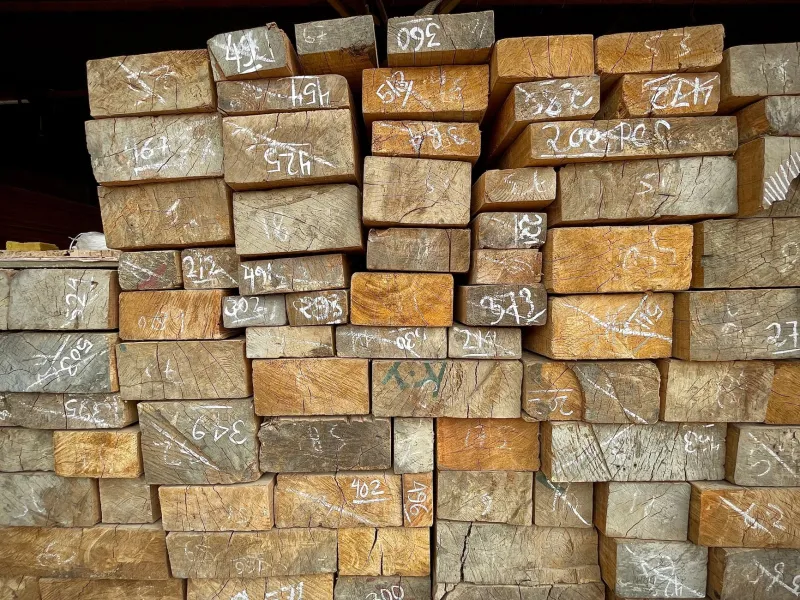
Before you touch anything, look at how the timber is stored. Boards should be flat, on bearers, with stickers (thin strips of wood) between layers to let air move. Stacks that lean, sag or have boards overhanging the ends are telling you something.
Plastic sheeting wrapped tight around green wood is a warning sign. So is a rack where everything is dusty and no one has moved it since the last bank holiday — it usually means the stock is old and the staff are indifferent.
End grain does most of the talking
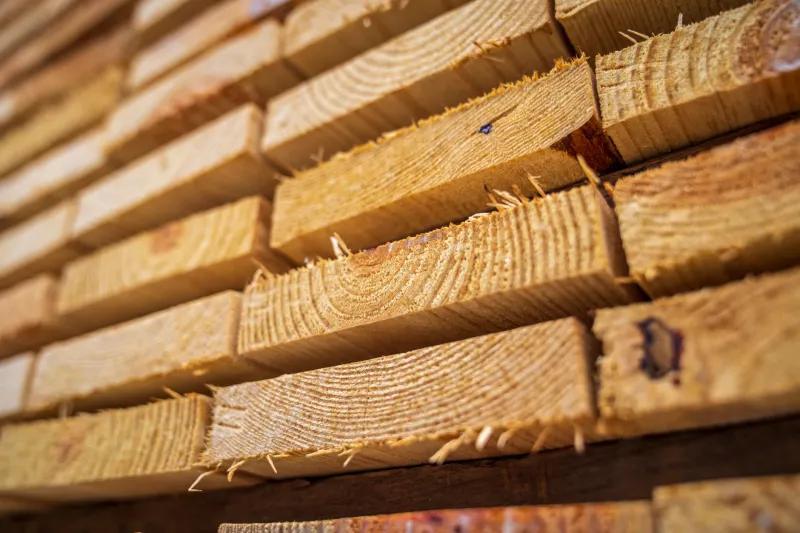
The end of a board is a cross-section of its whole life. Look at it closely.
Wide growth rings mean fast-grown timber, which is more likely to move. Tight rings mean slower growth and greater stability. A dark pith running near the edge will often split. Fine radial cracks radiating out from the centre are ring shake, and that board is firewood.
If the ends are painted or waxed, that's normally a good sign — someone cared. Ask if you can take a fresh look at a cut end, or just sight the face.
Cup, bow, twist: the ten-second test
Stand the board on its edge and sight down its length. Any curve along the length is bow. Lay it flat and look across the width for cup. Then — the one most people forget — check for twist by standing it on a flat surface and pressing alternate corners. If it rocks, it's winding, and it will fight you all the way through the build.
A short straight edge and a pair of winding sticks in your boot bag will turn guesswork into certainty.
Knots, sap and 'character'
Live knots are tight, solid and integral to the grain. Dead knots are loose, dark-ringed and will fall out or stop your plane dead. On a structural piece, dead knots are a genuine problem; on a decorative panel, they're a nuisance.
Sapwood is the pale outer band. It's softer, absorbs finish differently and is a favourite of woodworm. Some species — oak especially — should be mostly heartwood for anything that matters. Ask whether the price reflects a sap allowance or hides one.
The questions worth asking out loud
You'll feel awkward the first time. Ask anyway; staff at a good yard respect it.
- Where is this from, and what species exactly is it?
- Is it kiln dried, and to what moisture content?
- Can I pick through the stack myself?
- Can you machine it for me, and what's the charge?
- How is it priced — per cubic foot, per cubic metre or per linear metre?
- What's your returns policy on timber?
That last one matters more than people think. A yard that lets you bring back a board that turns out to be rubbish is a yard worth keeping.
Do the price sums properly
Hardwood is usually quoted per cubic foot (some yards use cubic metres). Softwood often goes by the linear metre, which tells you nothing about volume. Convert everything to a like-for-like figure before you compare.
Watch the difference between rough sawn and PAR — planed all round. PAR is convenient, but you pay for the machining and you lose thickness: a nominal 25mm board can arrive at 20 or 21mm. If your project needs a finished 22mm, don't buy a 25mm PAR and hope.
And be sceptical of 'grade A' claims. Grading is not standardised across the trade. Look at the board, not the label.
Why the relationship still wins
Online timber buying is fine — genuinely fine — for a known species in a known size, when you can accept some variation. But you're buying a photograph and a promise. You cannot sight the grain, check for twist or reject the one bad board in the bundle.
A local merchant gives you something an algorithm can't: a person who remembers you. Once they know you're not a time-waster, good things happen. They ring you when a nice load of ash arrives. They let you into the offcuts bin. They'll tell you honestly that the board you've picked is the best of a bad batch.
That's worth paying a small premium for. It's also the fastest way to learn — five minutes of a yard manager's opinion will teach you more about reading grain than an evening of forum threads.
Kit to take with you
Tape measure, moisture meter, a small square, a short straight edge, chalk, a pencil and a notebook with the project's cut list written in it. Buying without a cut list is how you end up with three beautiful boards and nothing you can actually make.
Buy less timber than you think you need, buy it better, and buy it from someone whose name you know. That's the whole method.